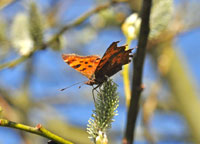
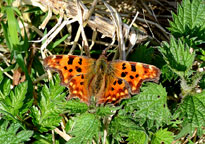
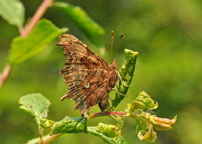
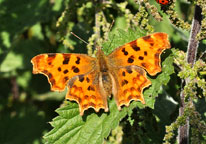
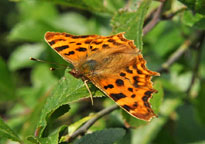
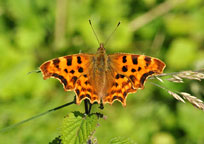
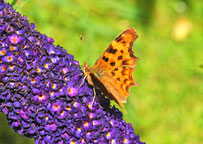
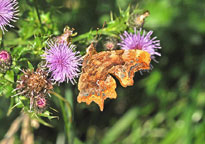
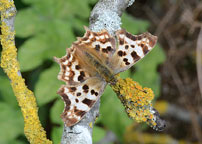
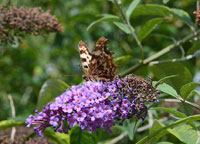
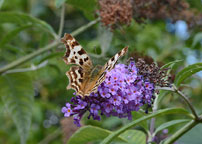
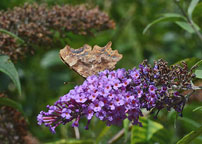
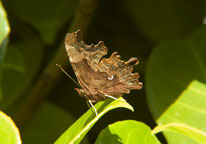
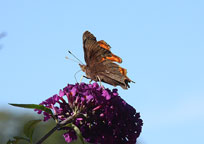
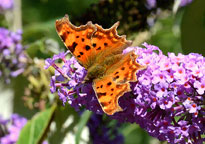
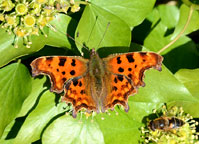
The Comma is fairly common in Great Yeldham, though mostly seen as the odd one or two at a time.
Individual males can be seen on the same perch, such as on the side of a sunny hedge, for many days in succession. Their most favoured perching spot in the paddock at Roseland House, is in the south-east corner against a tall Blackthorn hedge. They usually appear in the afternoon after the sun has got round to the east.
There are two broods per year. The overwintered adult females lay eggs in April-May to produce the summer brood which emerges in June-July. This brood in turn lays eggs to produce a second brood which emerge as adults in August to early September.
The darker butterflies are produced when the caterpillars have shorter days, and hibernate as adults. They are seen in the autumn and again in the spring.
The larval foodplants are Hops, nettles or Elm.
Forms: 2012. Typical up to June 14. Hutchinsoni: July 3 - Sept 1. Typical from Sept 4